





Can cast aluminum rotors also experience eccentricity issues?
Eccentricity of cast aluminum rotors is a common problem in the production and maintenance of asynchronous motors, and a major contributing factor to excessive motor vibration, abnormal noise, premature bearing wear, and rotor rubbing failure. Many after-sales service personnel tend to attribute motor vibration problems simply to improper assembly or bearing damage. However, the vast majority of eccentricity issues originate during the rotor casting stage. Later high-speed operation, load impacts, and bearing wear will continuously amplify the eccentricity defect, triggering a series of chain failures and severely impacting the stable operation and service life of the equipment.
Eccentricity in cast aluminum rotors is mainly divided into two types: inherent eccentricity during casting and eccentricity during later operation. During the casting stage, uneven aluminum melt flow rate, mold positioning misalignment, and misalignment of the core laminations can lead to uneven thickness of the end rings at both ends of the rotor and asymmetrical weight distribution in the solidified aluminum layer. This results in a shift in the rotor's center of gravity after forming, creating an inherent eccentricity defect. Simultaneously, long-term mold wear and insufficient mold closing precision can also cause excessive coaxiality between the cast aluminum squirrel cage and the rotor core. During assembly and operation, substandard machining precision of the motor shaft, uneven pressure during core pressing, and slight shaft bending can further exacerbate the eccentricity problem. Furthermore, long-term high-speed operation, load impact, and increased bearing wear clearance can cause the rotor's rotation center to continuously shift, forming dynamic operational eccentricity. This type of eccentricity is gradual and intensifies over time.
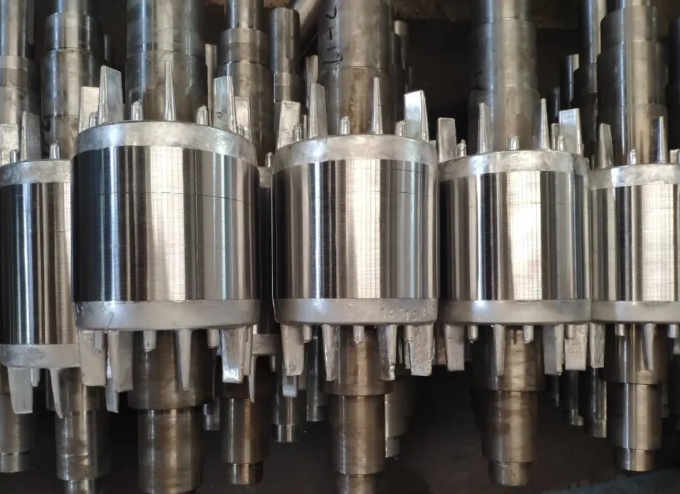
Rotor eccentricity poses a continuous and irreversible threat to motors. Eccentricity directly disrupts the uniformity of the air gap between the stator and rotor, generating periodic unbalanced magnetic pull, causing high-frequency vibrations and harsh noises during motor operation. Long-term reciprocating vibration continuously strains the connection between the cast aluminum conductor bars and the end rings, accelerating fatigue crack formation and ultimately leading to rotor bar breakage. Severe eccentricity can cause localized friction rubbing between the stator and rotor, not only wearing down the stator core and burning out the winding insulation, but also melting localized aluminum conductor bars due to the high temperatures generated by friction, resulting in permanent damage. Simultaneously, uneven air gaps significantly increase electromagnetic and mechanical losses in the motor, leading to higher motor temperature rise, fluctuating operating current, and insufficient output. This not only increases energy consumption but also accelerates bearing wear and aging, significantly increasing equipment maintenance costs.
Solving rotor eccentricity issues requires adherence to guaranteed process equipment, process flow monitoring, and controllable and stable process fluctuations. On the production side, regular mold inspection and calibration are essential to ensure mold closing accuracy and positioning benchmarks. Optimizing the aluminum casting process ensures symmetrical and uniform aluminum layers on the rotor. After molding, rigorous dynamic balancing testing is crucial to accurately eliminate eccentric or out-of-balance defective products. On the assembly side, strict control over shaft machining accuracy and core pressing processes is vital to prevent deformation under stress and coaxiality deviations. For eccentric rotors requiring urgent attention under specific operating conditions, deviations can be corrected through precision turning and dynamic balancing. In routine maintenance, regular checks of bearing clearance and rotor coaxiality are necessary. Worn bearings should be replaced promptly, and equipment installation level should be corrected to prevent eccentricity from worsening at its source, ensuring stable and low-noise motor operation.
 XINDA
XINDA