






Why is the starting current of a motor high, but the current decreases after starting?
1. First, understand the structure of the AC three-phase squirrel-cage asynchronous motor.
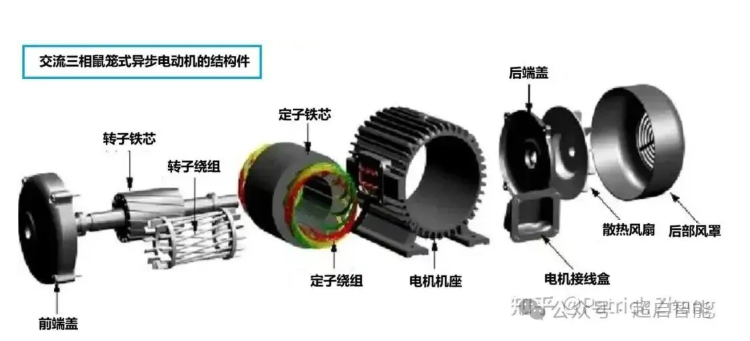
Figure 1: Structural components of a three-phase squirrel-cage asynchronous motor
If we look closely at the rotor in Figure 1, its windings are actually squirrel cage bars, and they have a certain inclination direction.
2. Reasons for the decrease in current after motor startup
When we apply three-phase alternating current to the stator windings of a motor, a rotating magnetic field is generated in the air gap between the stator and rotor. This is crucial, as shown in the diagram below:
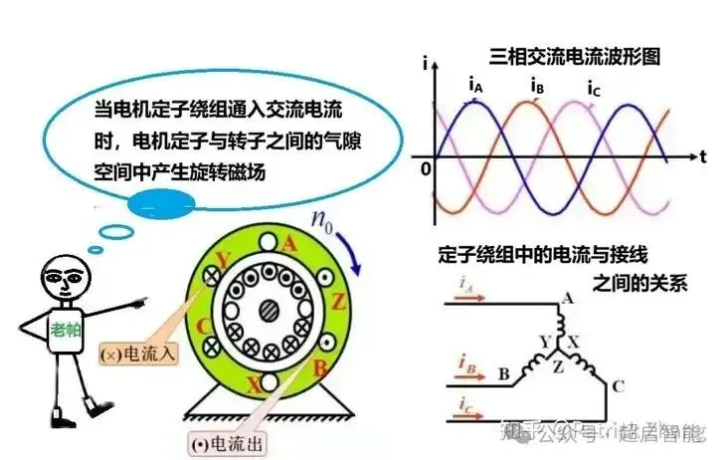
Figure 2: After being powered on, the stator windings of an AC motor generate a rotating magnetic field.
When the motor is first powered by AC, the rotor has not yet rotated and cannot generate a back electromotive force to cancel out the power supply voltage. At this time, almost all of the power supply voltage acts on the resistance of the stator windings. Because the resistance of the stator windings is very small, the stator current, which is also the motor current, is at its maximum.
As the motor rotor speed increases, the back electromotive force generated by the rotor gradually increases, offsetting part of the power supply voltage and reducing the actual voltage acting on the windings. Consequently, the current also decreases. The rotor output torque also decreases.
Note 1: Two key points: the rotating magnetic field generated by the stator, and the back electromotive force generated by the rotor.
Note 2: Therefore, it can be concluded that the rotational speed of the motor rotor cannot reach the synchronous speed n0.
This explains why the current is high when the motor starts but decreases during normal operation, as shown in the diagram below:
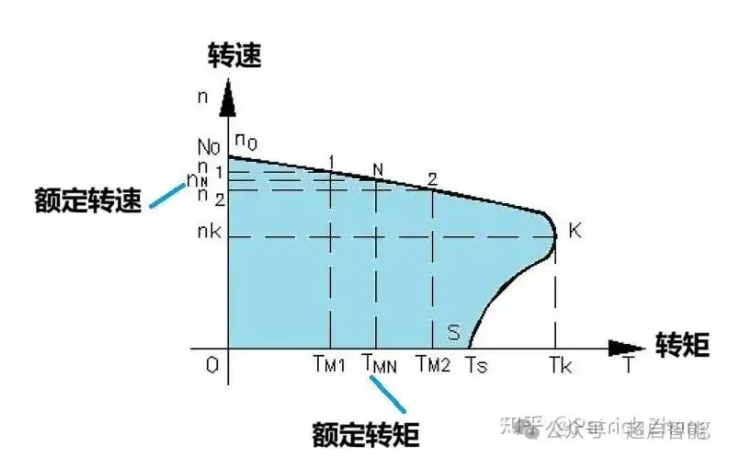
In Figure 3, the rated speed of the motor is nN, and the corresponding rated torque is TMN. We can see that near the rated speed nN, when the motor speed decreases, the torque increases and the current also increases; when the motor speed increases, the torque decreases and the current also decreases.
As we can see from Figure 3, the torque has a maximum value, and the corresponding motor current also has a maximum value, which is called the peak starting current, and is generally 10 to 12 times the rated current of the motor.
When the motor speed is lower than the speed corresponding to the peak starting current, torque and speed increase together. However, when the motor speed is higher than the speed corresponding to the peak starting current, the higher the speed, the lower the torque. Why is this?
We call the region between the peak starting current and the rated current the starting stage of the motor. Its average current is between 4.2 times and 8.4 times the rated current, and it is generally calculated as 6 times the rated current.
When the motor enters a stable operating state, the motor current is the rated current In. At this time, the expression for the output power Pn on the rated shaft of the motor is:
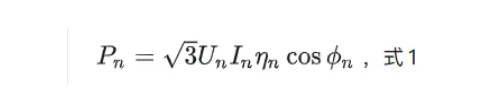
Substituting the voltage 380V and two 0.8 values into Equation 1, we can approximate that the motor's rated current In is twice the motor's rated power Pn. Multiplying this by 6 gives us the motor's starting current.
 XINDA
XINDA